Learning Hub.
The Kwalifai dictionary of essential finance. Master the mechanics of your mortgage with our plain-English guide to complex terminology.
Choose your path
First-Time Home Buyer
Master the basics and secure your first home with confidence.
Learn the terminology
Browse 'Qualification' and 'Process' tags in our dictionary.
Run scenarios
Use our Buy Down and Purchase Power tools to model your deal.
Set Rate Alerts
Let Lowi AI monitor the market and notify you when your target rate hits.
Existing Homeowner
Optimizing your current mortgage for maximum equity and cash flow.
Monitor the spread
Watch the 10Y Treasury yield on our Market Rates page.
Set Rate Alerts
Let Lowi AI notify you when your target ROI is hit.
Calculate ROI
Determine if closing costs outweigh the interest savings.
Rate Strategy
Tactical financing maneuvers to lower your long-term interest cost.
Learn Buydown Types
Understand the difference between 2-1 temporary and permanent points.
Seller Credit Logic
Negotiate for credits that fund your rate reduction.
Break-even Analysis
Identify the exact month your upfront investment pays for itself.
Closing Disclosure
Deconstruct your final settlement costs and defend against junk fees.
Review the 3-day rule
Learn your legal right to review all costs before signing.
Audit Section C
Compare your title and settlement fees with your Loan Estimate and with other quotes.
Verify tolerances
Confirm which lender charges cannot rise versus your original Loan Estimate.
Loan Estimate
Deconstruct your initial mortgage offer and shop with maximum buyer leverage.
Trigger the 3-day window
Understand your legal right to receive your LE within three business days of applying.
Audit Section A fees
Compare lender overhead and origination costs side-by-side to find discrepancies.
Lock in your Rate Alert
Monitor treasury yields with Lowi AI to capture rate drops while you shop.
Title & Settlement
Title insurance and settlement fees are among the few closing costs you can usually shop. Learn how they work, then run your own numbers.
Title & Settlement guide
Owner’s vs. lender’s policies, how premiums are set, your right to shop, and discounts to ask for.
InteractiveTap through a Closing Disclosure
Every line explained, with the title and settlement lines highlighted.
CalculatorTitle & closing cost calculator
All 50 states and DC, with exact state-set premiums in Texas and Florida.
CheckerCheck my Loan Estimate
See whether the title fees on your Loan Estimate look in line.
How it works
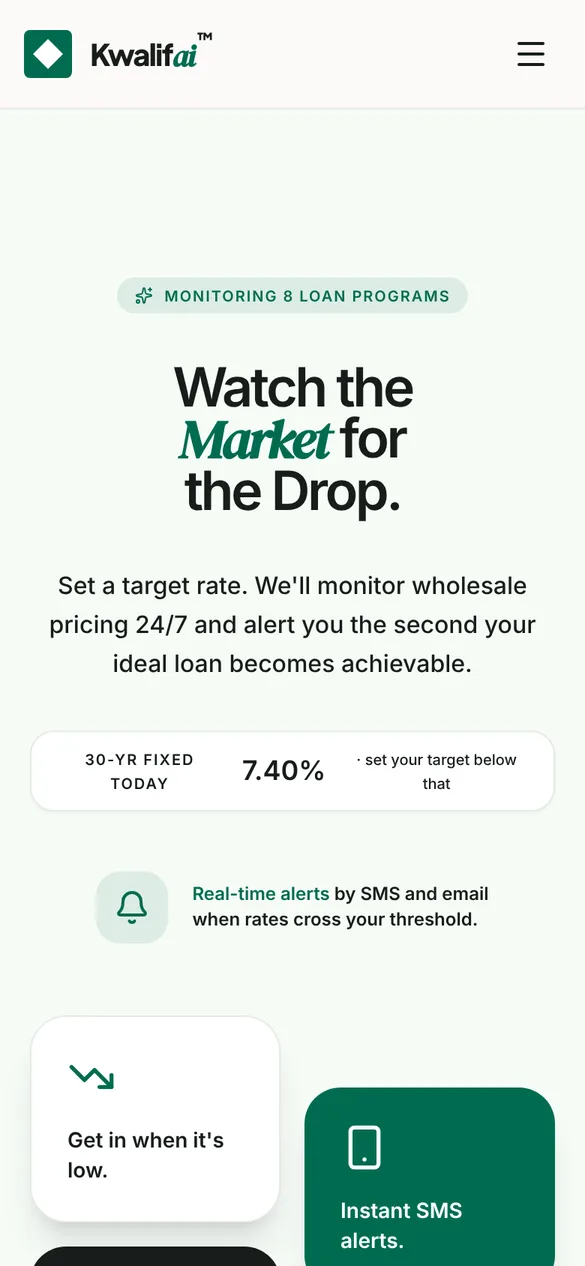
Set a target once. Stop checking rates.
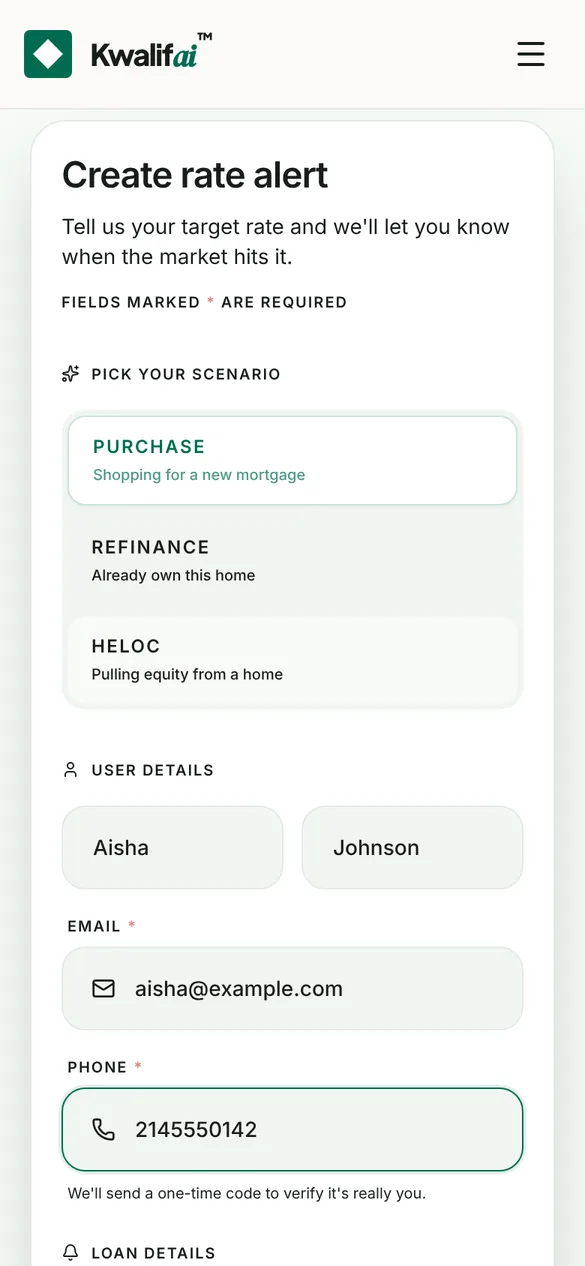
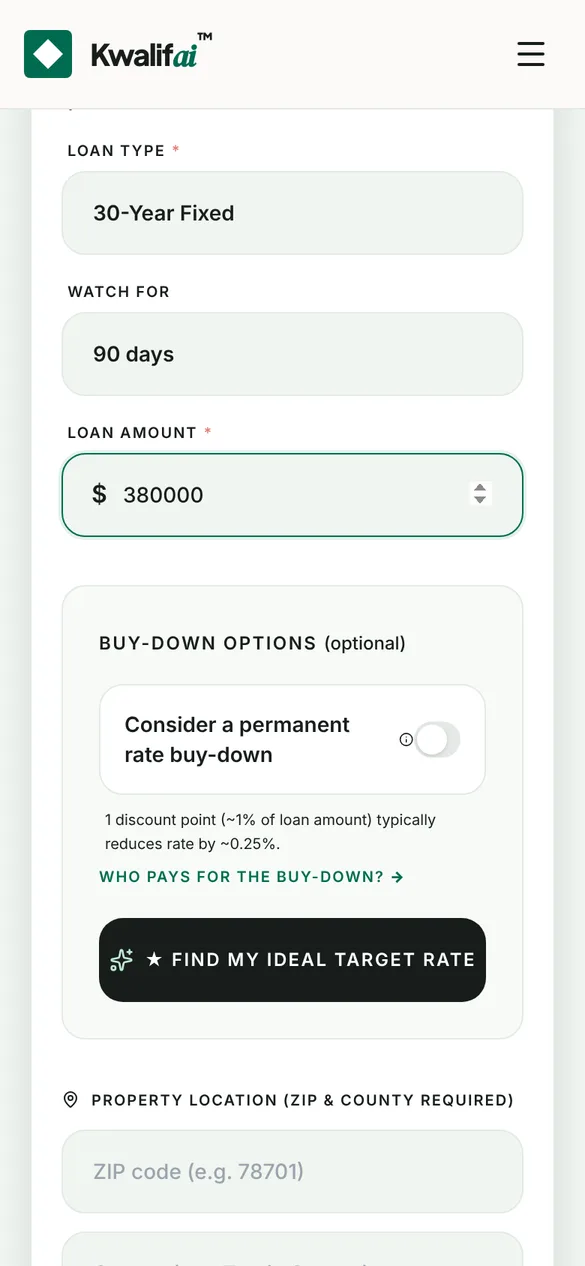
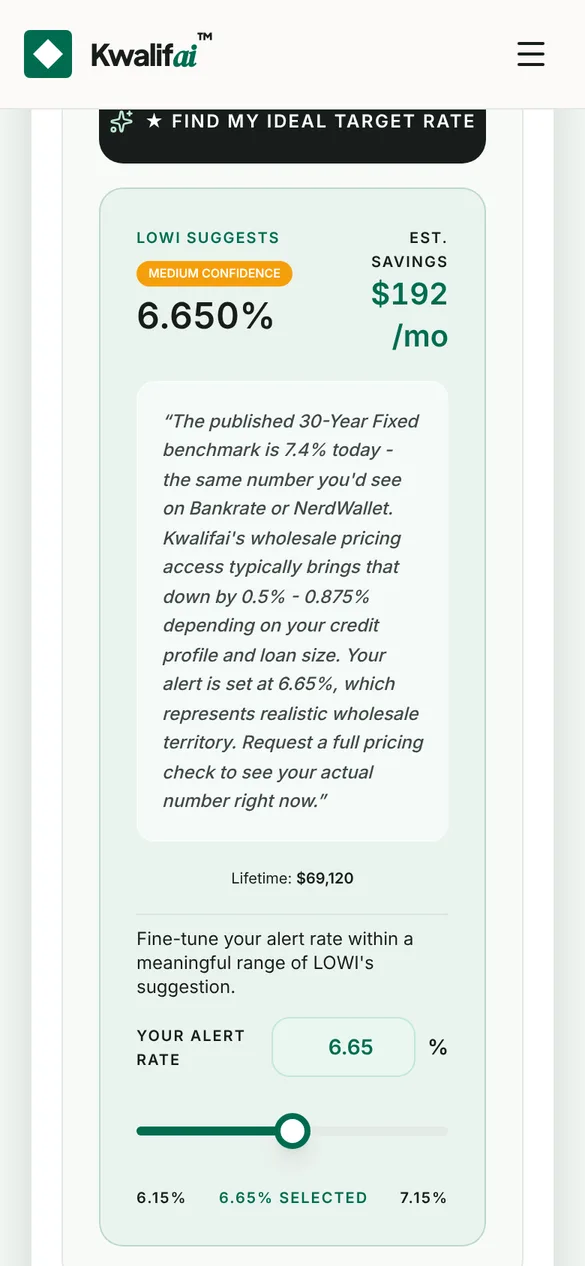
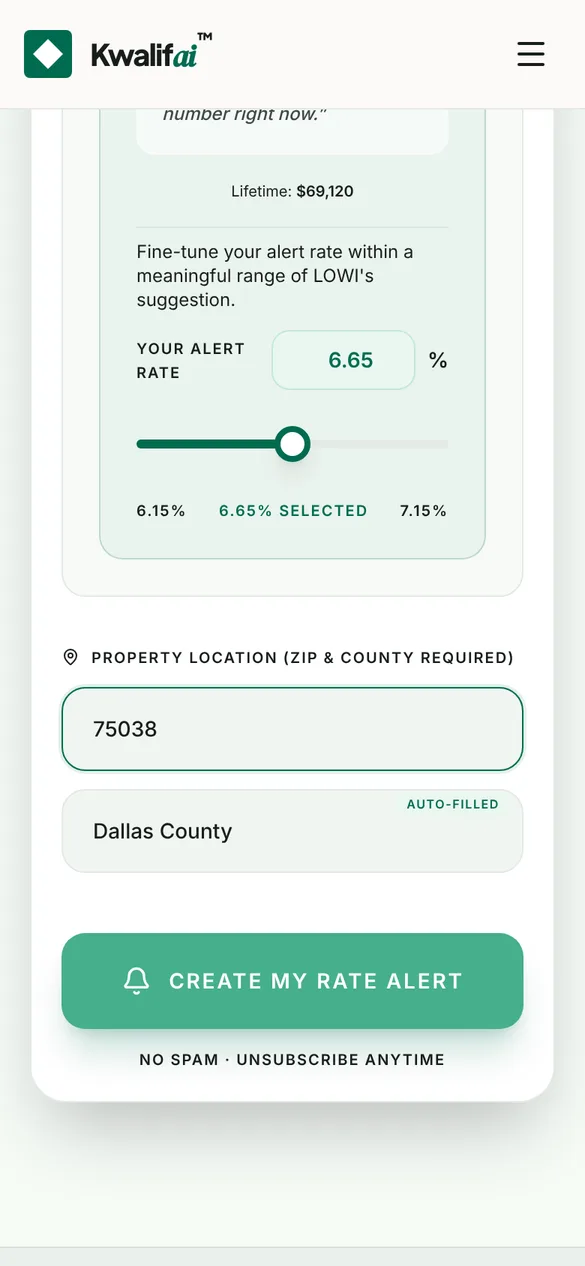
Tell Kwalifai the loan you want and the rate that makes it work. Lowi AI helps you pick a realistic target, then we watch wholesale pricing 24/7 and text you when it gets there.
Kwalifai
Right after you create it
Kwalifai: Your rate alert for 30-Year Fixed at 6.65% is active. We’ll text you when rates are in range. Reply STOP to opt out.When the market gets there
Kwalifai: 30-Year Fixed is now near your target. Current: 6.66%, your target: 6.65%. Check your dashboard or talk to a loan expert. Reply STOP to opt out.Example messages. Your numbers will differ.
Step 1 of 6
Screens from kwalifai.com with a sample borrower. Suggested rates and savings are estimates, not a quote or a commitment to lend. Text messages show example numbers.
Set my rate alertBrowse the dictionary
Rate Buydown
A financing technique where the buyer, seller, or builder pays an upfront fee (often called points) to lower the mortgage interest rate for a specific period or the life of the loan.
DTI (Debt-to-Income)
A personal finance measure that compares an individual's monthly debt payment to their monthly gross income.
PITI
Stands for Principal, Interest, Taxes, and Insurance: the four components of a monthly mortgage payment.
APR (Annual Percentage Rate)
The annual cost of a loan to a borrower, including interest and fees, expressed as a percentage.
Private Mortgage Insurance (PMI)
Insurance required by lenders for conventional loans when the down payment is less than 20% of the home's value.
Escrow Account
An account where money is held by a third party to be paid to others, typically for property taxes and homeowners insurance.
Closing Costs
Fees paid at the end of a real estate transaction, including appraisal fees, title insurance, and loan origination fees.
Loan-to-Value (LTV)
A ratio used by lenders to express the amount of a first mortgage lien as a percentage of the total appraised value of real property.
Discount Points
Fees paid directly to the lender at closing in exchange for a reduced interest rate (also known as "buying down the rate").
Amortization
The process of paying off a debt over time through regular payments of principal and interest.
ARM (Adjustable Rate Mortgage)
A mortgage with an interest rate that is linked to an economic index and adjusts periodically.
Underwriting
The process a lender uses to determine the creditworthiness of a potential borrower.
Pre-Qual vs Pre-Approval
Pre-qualification is an estimate based on your self-reported data; pre-approval is a conditional commitment based on verified documentation.
Fixed vs Adjustable Rate
Fixed rates stay the same for the life of the loan; adjustable rates change based on market conditions after an initial period.
Conforming vs Jumbo Loans
Conforming loans follow limits set by Fannie Mae and Freddie Mac; jumbo loans exceed these limits for luxury or high-priced properties.
Rate Lock
A guarantee from a lender that the interest rate will not change for a set period while the loan is being processed.
Closing Disclosure (CD)
A 5-page TRID form providing final loan terms, projected monthly payments, and a precise itemization of closing fees, delivered 3 days before signature.
Loan Estimate (LE)
A 3-page TRID form delivered by lenders within 3 business days of application, itemizing interest rate, projections, and estimated closing costs.
TRID 3-Day Rule
The TILA-RESPA Integrated Disclosure rule stating lenders must give you the Closing Disclosure at least three business days before you sign your mortgage.
Title Insurance
Insurance against losses from ownership problems that existed before you closed: forged deeds, unknown heirs, missed liens, and public-record errors. One premium, paid at closing.
Owner’s Title Policy
Protects your equity, usually up to the purchase price, for as long as you or your heirs own the home. Optional in most places.
Lender’s Title Policy
Protects the lender’s lien up to the loan amount. Most lenders require one, and the borrower usually pays for it.
Simultaneous Issue
Buying the owner’s and lender’s policies together on a purchase, so the lender’s policy costs only a small add-on fee ($100 in Texas, $25 in Florida).
Reissue Rate / Refinance Credit
A discount on a new policy when a recent policy already covers the home. Texas gives refinances a 25% to 50% credit (rule R-8); Florida offers reissue rates.
Promulgated Title Rates
Premiums set by the state regulator, so every title company charges the same premium for the same policy. Texas, Florida, and New Mexico work this way.
Title Search
A review of public records for the property’s ownership history, liens, judgments, easements, and unpaid taxes.
Title Commitment
The title company’s promise to issue a policy once listed requirements are met. Schedule A names the parties and amounts; Schedule B lists requirements and exceptions.
Title Exception
An item the policy specifically does not cover, such as recorded easements, deed restrictions, HOA covenants, mineral rights, or survey matters.
Title Endorsement
An add-on that changes a policy’s coverage, for example for a condo, a planned unit development, an adjustable-rate loan, or environmental liens.
Closing Protection Letter (CPL)
A letter from the title insurer covering losses if the closing agent mishandles funds or ignores closing instructions.
Settlement Agent
The company or attorney that runs the closing: holds and disburses funds, prepares the settlement statement, and records the documents.
Written List of Service Providers
A list your lender must give you of settlement providers for the services you may shop for, within three business days of your application.
Transfer Tax
A state, county, or city tax charged when ownership changes. Also called a deed tax, excise tax, or documentary stamp tax.
Recording Fees
County charges to enter your deed and mortgage in the public record. Listed in Section E of the Loan Estimate.
Lien
A legal claim against a property for an unpaid debt: a mortgage, taxes, HOA dues, a contractor’s bill, or a court judgment.
Cloud on Title
Anything that casts doubt on ownership, such as an unreleased old mortgage, a missing heir, or a recording error.
Deed
The signed document that transfers ownership from seller to buyer. A general warranty deed carries the broadest seller promises; a special warranty or quitclaim deed carries fewer.
Survey
A map of the property’s boundaries, improvements, easements, and encroachments prepared by a licensed surveyor.
Closing Wire Fraud
Criminals email fake wiring instructions that look like they came from your title company, agent, or lender.
Apply your knowledge
today.
Now that you know the terms, see how they apply to your specific financial profile. Use Lowi AI to run real scenarios.